
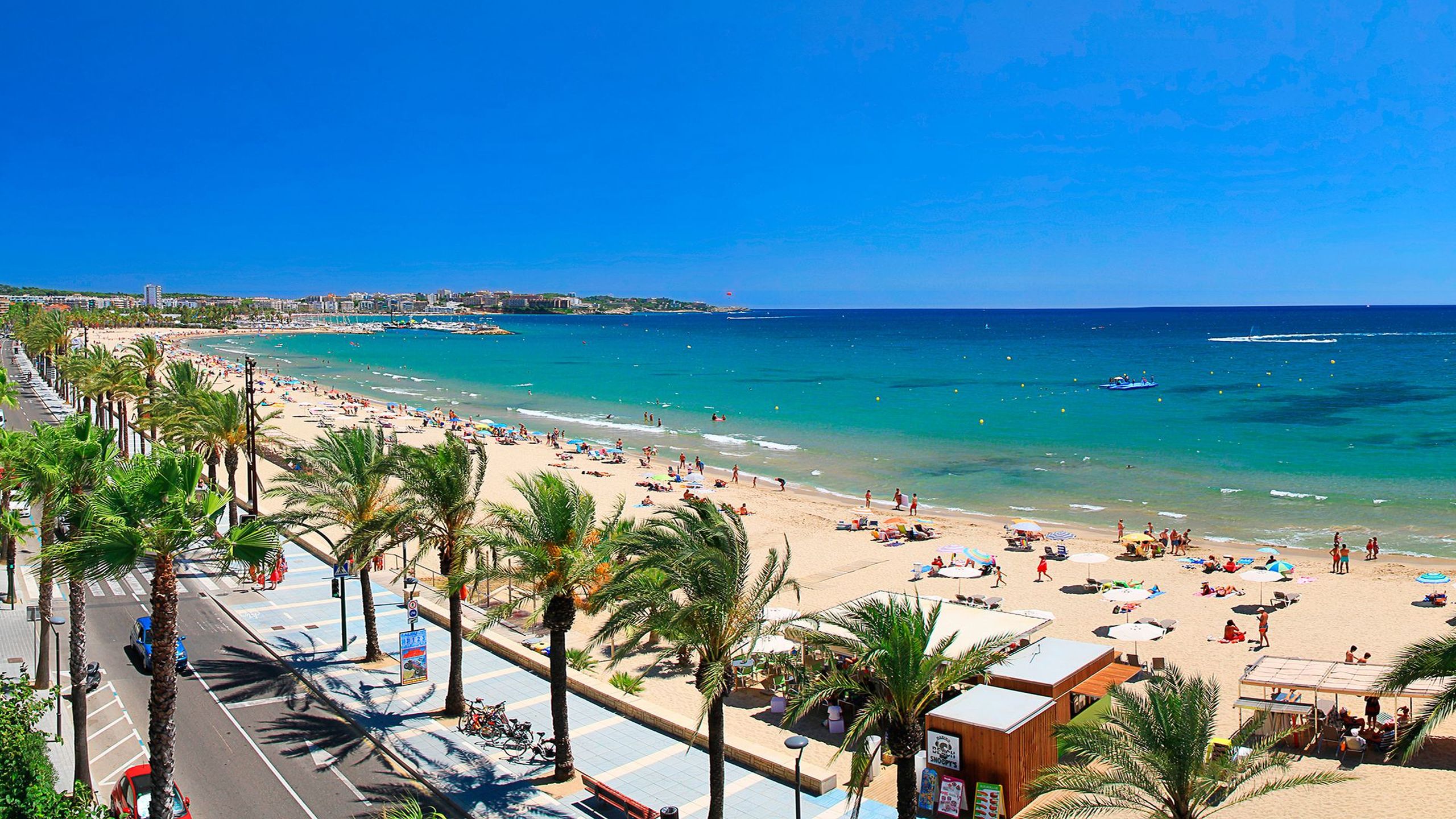
Salou is the tourist capital of the Costa Daurada and one of the most complete destinations in the Spanish Mediterranean. Located 100 km from Barcelona, 12 km from Tarragona and 5 km from PortAventura, this former fishing village in southern Catalonia combines nine kilometers of coastline, a well-preserved old town, first-class tourist infrastructure and a Mediterranean climate with more than 300 days of sunshine a year.
In this guide we collect what any traveler should know before coming: history, beaches and coves that are really worthwhile, what to visit inside and outside the town, how to get there, when to travel depending on what you are looking for and where to stay. We write it from Apartamentos Mare Nostrum, a family business dedicated to holiday rentals in Salou since 1999. In fact, the founding family has been vacationing here since 1965, half a century of knowledge and affection for the place transmitted as a family legacy.
History of Salou: from fishing village to tourist destination
The name of Salou appears in documents as early as Roman times as Salauris, the natural outlet to the sea of the ancient Tarraco. For centuries it was a small marina dependent on Vila-seca, with an economy based on fishing and coastal trade. In the Middle Ages was built the defensive tower against Berber attacks that still presides over the historic center, the Torre Vella, declared a Cultural Asset of National Interest.
The great transformation came in the second half of the twentieth century. Salou was one of the first towns on the Costa Daurada to open up to international tourism in the 1960s, attracting French, German and British visitors looking for sun, sea and moderate prices. A key milestone of those years was the founding of the Club Nàutic Salou in 1964, under the presidency of the jurist Antoni Pedrol Rius. The inauguration of its Port Esportiu on July 8, 1969 provided the town with modern nautical infrastructure and, throughout the second half of the 20th century, the club acted as the driving force behind Salou’s social and sporting life: the venue for international regattas – including the European Championship in the 470 class in 1984 and the World Championship two years later – the popular Regates del Rei Jaume and a sailing school that continues to train sailors to this day.
In 1989 it was constituted as an independent municipality of Vila-seca. The opening of PortAventura in 1995 definitively consolidated Salou as a family destination of reference in the Mediterranean, adding to the sun and beach product a leisure offer on a European scale.
Today Salou has about 26,000 registered inhabitants, a figure that is multiplied by five in high season, and its economy revolves around tourism, services and hospitality.
The beaches and coves of Salou
Salou has nine kilometers of coastline where urban beaches of fine sand coexist with more secluded coves in the Cap de Salou. All the main beaches have Blue Flag and surveillance in season.
Platja de Llevant
The main beach and the best known. A kilometer of fine golden sand in front of the Paseo Jaume I. It has all the services (showers, toilets, hammock rental, water sports, adapted accessibility) and connects to the town center. It is the typical choice if you come with small children: the descent into the water is very smooth and there is constant surveillance.
Platja de Ponent
800 meters west of the port, separated from Llevant by the pier. Quieter, also familiar, with parallel tree-lined promenade. Good alternative if you are looking for Llevant but with less density.
Capellans Beach
Small urban beach of about 200 meters, integrated in the hull. Calm waters due to its orientation. It is usually the favorite of families with babies.
Platja Llarga
Another kilometer of coastline but with a completely different environment: dunes, pine forests and less urbanization. This is the option if you prefer a beach with a more natural feel, without losing services.
The coves of Cap de Salou
To the south of the municipality, where the rocky coastline forms the Cap de Salou, there is a sequence of small coves accessible on foot along the Camí de Ronda: Cala Crancs, Cala Penya Tallada, Cala Vinya and Cala Font. They are the most photogenic beaches of Salou, with transparent water, rocky bottoms for snorkeling and much less noise than the urban ones. Arrive before 10 o’clock in July and August if you want a spot.
The Camí de Ronda
Walking along the coves of Cap de Salou following the Camí de Ronda is probably the most underrated plan of the municipality. It is about 7 km round trip between cliffs, coves and pine trees, with panoramic viewpoint to the lighthouse. Well signposted, suitable for any level, and free.
What to visit in Salou and surroundings
PortAventura World and Ferrari Land
Just 5 km from the city center, PortAventura is the most visited theme park in southern Europe, with six themed areas, world-class roller coasters (Shambhala, Dragon Khan, Furius Baco) and daily shows. In the same complex, Ferrari Land adds since 2017 Italian-themed attractions and the Red Force, the highest and fastest roller coaster in Europe. And next to both, PortAventura Caribe Aquatic Park for the warmer months. Three parks in the same enclosure.
The Lighthouse and the Cap de Salou
The Salou Lighthouse marks the tip of the headland and is easily reached on foot or by car. The views from the viewpoint cover the entire coast to Tarragona to the north and Cambrils to the south. Spectacular sunset.
Paseo Jaume I and Font Lluminosa
The promenade of Salou, modernist, with palm trees and mosaics, is the heart of the tourist town. At its eastern end is the Font Lluminosa, a fountain with night show of water, light and music in season. A classic free plan for summer evenings.
Roman Tarragona – UNESCO Heritage 12 km away
Tarragona was the Roman capital of northeastern Hispania and preserves the richest Roman monuments in the Peninsula after Merida: amphitheater facing the sea, circus, forum, walls. It has been declared a World Heritage Site by UNESCO since 2000. Half an hour by car or train. A must if you spend more than four days in Salou.
Cambrils, La Pineda and surrounding villages
Cambrils, 8 km to the south, is a fishing port with a renowned gastronomic tradition. La Pineda, 4 km to the north, has a very long beach and is an alternative when Llevant is saturated. Reus, 12 km inland, is the birthplace of Gaudí (Gaudí Centre museum) and home of the vermouth.
How to get to Salou
By car
| Origin | Distance | Approx. time |
|---|---|---|
| Barcelona | 110 km | 1 h 15 |
| Madrid | 550 km | 5 h 30 |
| Valencia | 260 km | 2 h 45 |
| Zaragoza | 215 km | 2 h 15 |
| Lyon (France) | 620 km | 5 h 45 |
Exit 35 of the AP-7 (Salou / Vila-seca / Cambrils). Access from Madrid is via the A-2 to Zaragoza and then the AP-2 / AP-7.
By plane
Reus Airport is only 10 km away and is the most direct option: seasonal flights from UK, Ireland, Belgium, Netherlands and Germany, mainly with Ryanair and TUI. Official information from AENA. Connection to Salou by cab (≈25 €) or shuttle bus.
Barcelona-El Prat Airport is 100 km away. More flights available all year round from any European capital. Connection by AVE to Camp de Tarragona (45 min train ride) or by direct bus Barcelona-Salou (about 1 h 45).
By train
The AVE Camp de Tarragona station is 15 km from Salou, with direct connection by cab (≈25 €) or local bus. From Madrid the AVE takes 2 h 30, from Seville 5 h 15, from Zaragoza 1 h 10. Information at RENFE.
The regional train R16/R17 also runs from Barcelona to Salou-Port Aventura station: 1 h 30 from Sants, much cheaper than the AVE.
When to visit Salou
Salou has a Mediterranean climate: warm and dry summers, mild winters, long and pleasant spring and autumn. More than 2,500 hours of sunshine per year.
| Month | Average temp. | Sea water | Occupation | Recommendation |
|---|---|---|---|---|
| January | 10 °C | 14 °C | Very low | For cultural visits (Tarragona) |
| February | 11 °C | 13 °C | Very low | Calçotada (seasonal gastronomy) |
| March | 13 °C | 14 °C | Low | Hiking, golf, warm beach |
| April | 15 °C | 15 °C | Media | PortAventura opening, Easter |
| May | 18 °C | 17 °C | Average | Recommended: ideal climate, moderate prices |
| June | 22 °C | 20 °C | High | Beach, parks, all open |
| July | 25 °C | 23 °C | Very high season | High season; book in advance |
| August | 25 °C | 24 °C | Very high | High season; peak prices |
| September | 22 °C | 23 °C | High | Recommended: warm water, less crowded |
| October | 18 °C | 20 °C | Average | Good weather, ideal for couples |
| November | 13 °C | 17 °C | Low | Cultural and gastronomic plan |
| December | 11 °C | 15 °C | Low | Urban getaway, Christmas markets in Tarragona |
If your priority is the beach, the month with the best price-weather ratio is September: the sea water is warmer than in July, everything is still open, but the town is much quieter and prices are lower than in August. May is the second best month for the same reason in the opposite direction.
Local gastronomy
The cuisine of Salou is typically Catalan coastal, with weight of fish and seafood from the fish market of Cambrils and the products of the Camp de Tarragona.
- Rossejat de fideos: thin toasted noodles with fried fish, served with allioli. The seafood specialty par excellence.
- Suquet de peix: rock fish stew with potatoes, garlic and ñora. Slow, fishermen’s dish.
- Romesco: cold sauce of almonds, ñora, tomato and virgin olive oil, originally from Tarragona. Accompanies grilled fish and vegetables.
- Calçots with romesco sauce: in spring (February to April), traditionally 20 km away in Valls. The calçotada is probably the most social food in Catalonia.
- DO Tarragona and DO Conca de Barberà wines: both less than an hour’s drive away. Winery visits available all year round.
Where to stay in Salou: hotel vs. tourist apartment
If you are traveling as a couple for two or three nights and you want hotel services (24-hour reception, restaurant included, gym), a hotel works. But for stays of 4 nights or more, with a family or group, renting a tourist apartment offers several advantages that should be considered:
- Space and privacy: living room, kitchen, separate bedrooms. Not “one room”.
- Fully equipped kitchen: saving breakfast and at least one meal a day substantially lowers the cost of the stay, and eating with a full fridge is healthier and more flexible than the hotel buffet.
- Own washing machine: for long stays, decisive.
- Best quality/price ratio in a family: 4 people in an apartment usually costs the same or less than two hotel rooms.
- Compulsory tourist license: in Catalonia, make sure that the apartment has HUT (Habitatges d’Ús Turístic). It is the legal guarantee that you are hiring accommodation in accordance with the regulations.
Mare Nostrum Apartments: our proposal
We have been managing tourist apartments in Salou since 1999. All our accommodations are 50 meters from the beach of Llevant, in the center, with tourist license HUT in order, capacity for 4-5 people, parking included, WiFi and air conditioning, and direct family treatment without intermediaries.
Check availability and make a reservation – Get to know Mare Nostrum – Contact us – Contact us
Frequently asked questions about Salou
What is the best beach in Salou for families with children?
Capellans and Llevant are the most recommended: calm waters, gentle descent, all services and constant surveillance. For teenagers who prefer something more natural and less urbanized, Platja Llarga.
Is it worth visiting Salou out of high season?
Yes, especially in May, June and September. The weather is good, everything is open, prices are lower than in July-August and there is much less tourist density. For cultural visits (Roman Tarragona) any month of the year works.
How many days do you recommend to visit Salou?
For a balanced stay (beach + PortAventura + surroundings), between 5 and 7 nights. A week allows you to enjoy the beaches, spend one or two days at the theme park, make an excursion to Roman Tarragona and another to Cambrils or Reus, without feeling rushed.
Are there supermarkets, pharmacies and services near the apartments?
Yes, the center of Salou has supermarkets (Mercadona, Lidl, Bonpreu), pharmacies 24 h in season, bakeries, gas stations and all kinds of stores on foot. Our apartments are less than 5 minutes walk from the first supermarket.
Is Salou expensive compared to other Mediterranean destinations?
Salou has a quality-price ratio clearly more favorable than the Costa Brava or the Balearic Islands for a family profile and average stay (4-7 nights). In low season (May, June, September) prices drop between 30% and 50% compared to July-August.
Is it possible to get to Salou without a car?
Yes, the AVE Camp de Tarragona station is 15 km away (cab 25 €), Reus airport is 10 km away, and the town center of Salou is completely walkable. For excursions to Tarragona or Cambrils there are local buses and the regional train.
Useful resources
Official websites and authorities to learn more about Salou and its surroundings:
- Ajuntament de Salou — official website of the Town Council
- Visit Salou (Tourist Board) — events agenda and official plans
- PortAventura World — tickets and opening hours
- Club Nàutic Salou — sailing school, regattas and moorings
- Costa Daurada Tourist Board — complete guide to the Costa Daurada
- Tarragona Tourism — visit the Roman monumental site (UNESCO)
- Reus Airport — AENA info on the nearest airport
- RENFE — AVE to Camp de Tarragona station and commuter trains to Salou-Port Aventura
- Salou on Wikipedia — encyclopedic entry
Ready for your getaway to Salou? Check availability and book directly without intermediaries at Apartamentos Mare Nostrum.